02 — Shadowhunter
One Bow, One Cloak, and the Shadows Themselves
You don't collect weapons in Shadowhunter. You learn increasingly ridiculous ways to use one bow, one cloak and the dark. A tour of the kit, from coyote time to the skyfall stab.
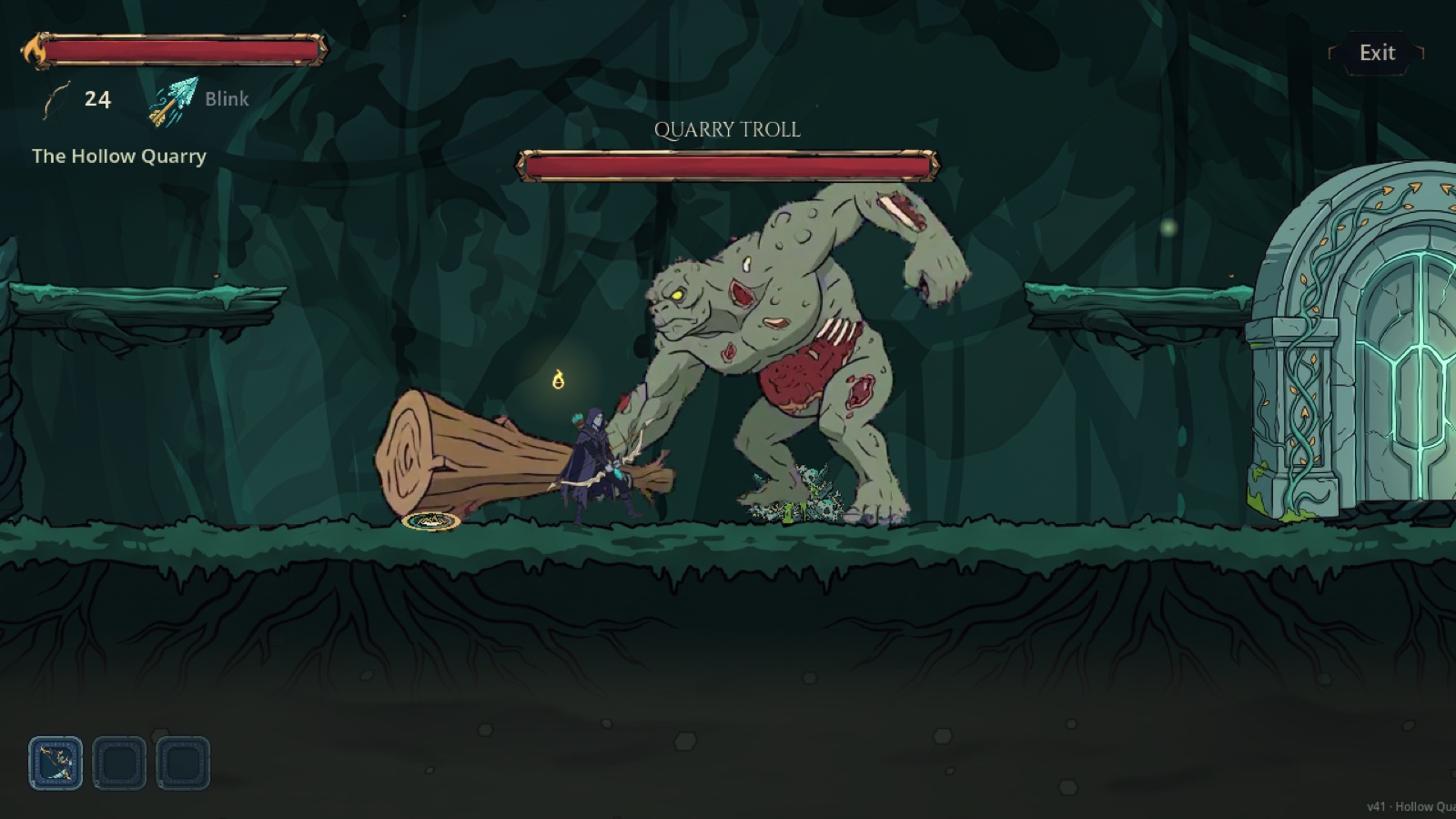
The first law of the project is that movement must feel fluid and addictive, and everything else is built on top of that. The controller has coyote time, jump buffering, a jump-cut on release, apex hang, heavier fall gravity, wall cling, slide and jump, dash ghosts, landing squash, camera lookahead, and hitstop plus screenshake on impacts. Every action cancels into the next according to a spec table, and animation never delays input.
Measured on the live controller: a single jump clears 4.2 tiles, a double jump around six, a dash covers 5.3, and the run moves 10.6 tiles a second. Those numbers are law for the level designers. Rooms are sized from them, not the other way around.
The bow
The Hunter's Bow does quick shots, a charged shot on aim-hold, kill-shot crits on head zones, an aerial slow-fall shot, a crouch shot and a downward lock from the air. Aim is a dedicated hold button, never a hold-attack. Cancelling a draw spends nothing.
Arrows are the cheap variety. Ten tips exist in the practice armory and four are earned in the campaign so far: Plain, Venom (a stacking rot), Flame (a burn that also ignites grass, tuft to tuft, and burns brambles away) and Blink, which teleports you to where the arrow lands. Rope arrows anchor a zipline. Ricochet, Pierce, Pin, Mark, Decoy and Shock are built and waiting for their rooms. The design rule that makes this a metroidvania rather than a loadout menu: arrow types are world keys. Flame opens brambles. Rope opens ravines. Blink opens gaps.
The Bladebow
The greatbow's limbs are blades. Equip it and the attack button stops meaning shoot and becomes a melee kit, all on one button so it works on a pad, a keyboard and the touch layout.
Tap three times for the chain: a flat cut, a faster return cut, and a rising finisher that launches. Forward and tap from rest for a lunge. Tap in the air for an air cut with a beat of hang. Dash and tap during the dash for the roll-stab, a low sliding thrust with invincibility frames. In the air, hold down and tap for the skyfall stab: a point-down dive that pogos off a body and buries the blade on landing, throwing everything nearby. Hold attack through a cut for the whirl, two full turns, both sides.
Rishi's verdict on the first prototype was two words: too strong. One whirl cleared a pack for a single stamina pip. The answer was half numbers and half enemies. The whirl now costs two stamina and staggers you on the last turn so it cannot chain, and the roster gained things that answer melee: elite rats that dodge a wind-up, Hollow archers that keep range, a Hollow Knight that parries the whirl, ember wisps the blade cannot touch. Act 1 is still meant to feel strong. Act 2 is built against it.
The Bladebow is allowed to feel strong here. Everything beyond the Gates is built against it.
— ABILITIES.md balance note
Four weapons, two hands
The newest local prototype gives the Hunter one equipped ranged bow and one equipped melee Bladebow with a quick swap. Thornstring is a compact forest bow with a crisp tapped follow-up shot at the cost of ammo. Oathcleaver is a heavy iron-limbed Bladebow whose third hit is an overhead ground cleave, slower to start and punishable if it misses. Both sit alongside the originals in the Practice Armory with three build presets. The rule for all of them: a heavy weapon changes the weight, timing and coverage of the verbs, never the verbs themselves, and it must never be universally faster, safer and stronger.